
What Causes Pilonidal Disease?
One would think that with a disease as common as pilonidal disease that clinicians would have a clear idea of what causes it. We do to some degree, and that understanding of the disease has changed over the decades. Initially it was believed to be a congenital “cyst”, but now it is believed to be a acquired process. It develops around the time that teenagers develop their adult body shape. There are three characteristics that specifically may contribute to the development of the disease:
- A deep gluteal (natal) cleft, AKA the butt crease.
- Possibly fragile skin in the midline of the crease.
- Possibly very stiff hair.
These three things can work together to cause pilonidal disease. It is believed that it starts in one of two ways:
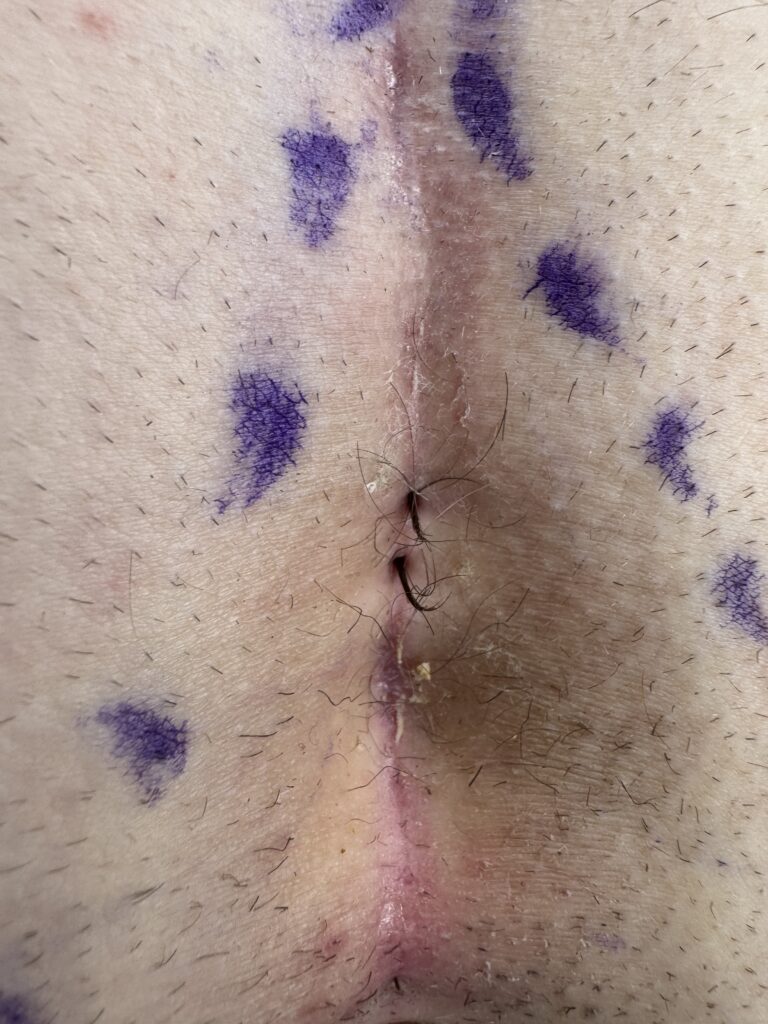
- Stiff hairs penetrate the skin, burrow underneath, and an enlarged pore develops at the site of hair penetration; or
- Pores develop in the cleft from pressure, and hairs find their way into the pores.
We see both of these processes in our patients, and at times both of these seem to be occurring simultaneously in the same patient. But, whichever way the process begins, it can progress to a painful cyst, an abscess, a sinus, or a wound.
There is no question that males have a higher incidence of pilonidal disease than women, in a ratio of 3:1 or 4:1. But there is no convincing evidence that obesity, hirsuteness, sedentary lifestyle, or personal hygiene play a significant role in the development of this problem.
How do we use this information?
Understanding the cause of pilonidal disease helps us determine which treatments are helpful. Promoting non-surgical treatment by telling a patient to shave the buttocks, shower more frequently, lose weight, or be more active is not usually particularly helpful (although this is exactly the advice often provided). Usually, once pilonidal disease becomes symptomatic, it does not completely resolve until surgically treated. The various operations for pilonidal disease may or may not take into account the causes mentioned above. The one operation that embraces the causes and attempts to correct them is the cleft lift procedure. This operation flattens the entire deep cleft; removes any existing pilonidal cysts, sinuses or wounds along with the weakened midline skin; and brings the incision off the center line. The fact that it addresses all of these issues explains the dramatic (>95%) success of this procedure, as compared to the others.